Automate all your repetitive HR tasks and save yourself hours every week to focus on your most important work.
Book a demoThe secret to the best employee onboarding experiences is simple: put the new hire at the centre of it.
Of course, the goal is to have happy, high-performing team members from day one. But when you’re running a small business of fewer than 30 people without a dedicated HR team, the real challenge isn’t caring about the new hire's experience – it's finding the time to deliver it properly alongside everything else on your plate.
The good news is you don’t need enterprise-level resources to create a brilliant onboarding experience. You just need the right onboarding best practices, the right structure and a few examples of what actually works at this scale.
At CharlieHR, it took us a while to build an onboarding process we were genuinely proud of. So we’ve rounded up the best onboarding practices we’ve built ourselves, along with the best ones we’ve seen from other small businesses – so you can borrow what works.
Don’t take it from a random guide online. Take it from people who have actually done this at a small business.
Leaving everything to the last minute can be tempting when you’re already swamped with work, but it will cause stress on both sides – yours and the new hire’s. The last thing you want is to give a bad first impression.
To avoid this, you should give new employees access to the right tools to succeed, which means preparing everything beforehand with some onboarding steps.
Here’s what you can think about sorting out before the new hire even sets foot in the office (before they log on, if remote):
At CharlieHR, we do the last two by sending new hires an invitation to our onboarding software where they’re taken through a step-by-step onboarding process. They can easily fill in their information and upload their documents – all without your help.
You get all your records in one place and securely stored – nothing gets lost in email threads.
This invitation should be part of a welcome pack that you’ll put together for your new hire. Once you’ve shared their email credentials (and asked to change their password for security reasons), they’ll have a welcome email for new employees right in their inbox that contains all of what they need to know.
Most of our new hires look at this information a few days before they start at CharlieHR, especially since we’re all working remotely, but you can adapt this depending on how you operate as a business (check out our remote onboarding guide for more info).
One of the best onboarding practices to remember is that you need to be ready before they start. That’s where I’d suggest having an onboarding checklist somewhere handy to make sure you don’t forget anything.
My way of doing it is going through the checklist template we’ve put together in CharlieHR – I can tag colleagues, set a due date to guarantee everything is done on time (without having to send chasers) and attach documents and links to checklist tasks. This enables new hires to work through a lot of it themselves.
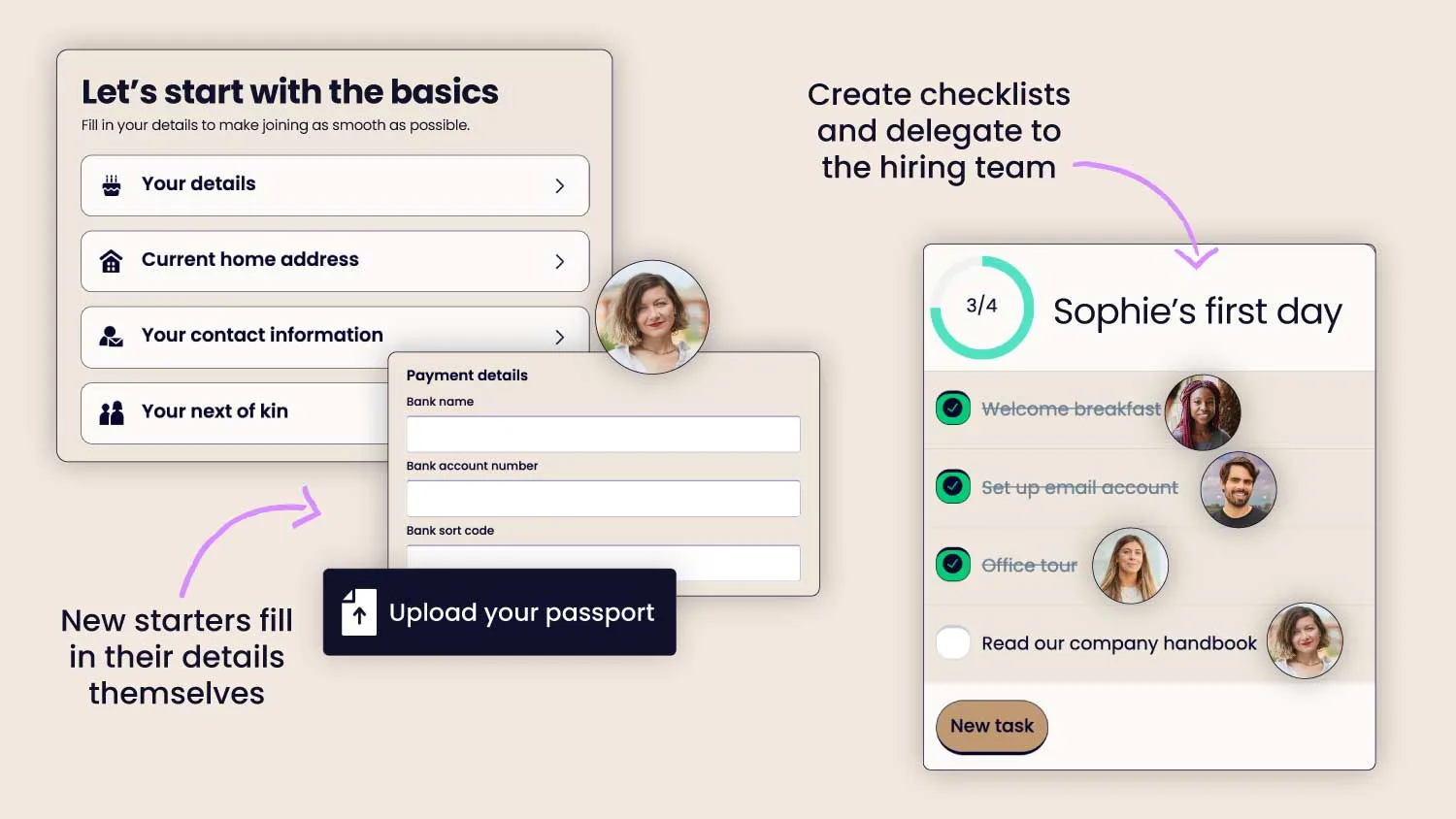
That also works if you want to offboard a team member with offboarding checklists.
First days mean a lot of people to meet, and a lot of information to absorb – it can sometimes feel like a blur for your new hire.
Your role here, and the best practice for your onboarding, is making new hires feel welcome and at ease in their new environment.
Depending on whether you’re working remotely or in the office, you can schedule a welcome chat to set the tone for the day. This will be their introduction to a familiar face in the company, and you should stay on hand for any other questions they might have. On their first day, your new hires will probably be making their way through a lot of documents, so take it easy with them and don’t rush anything.
Their line manager should be the next person responsible for making them feel welcome and providing context around the work they’re going to do. For someone working in marketing, for example, that might mean getting familiar with a tone of voice document and understanding the marketing strategy.
It can be completely different for someone who works in customer service. There’ll be a lot of learning to do around how the software works and how to answer people’s queries regarding their account or their billing, for example.
This may seem like an obvious onboarding best practice, but that can sometimes be overlooked by those juggling many hats in a small business.
It’s easy to get so wrapped up in policies and documents, that we don’t actually realise we’re the only ones who know where they’re stored.
Your welcome pack, which we mentioned earlier, should include links to any information needed by the new hire. It can include:
This is just a set of examples, and there might be other elements to add to your list. At Charlie, I send an invite to sign into our onboarding software straight away when the new hire starts – all this information is available there.
Let them flick through your handbook and policies with ease.
Give them access to essential information about the company, and your working locations as well as a directory to get to know their colleagues and where they’re located.
You need to know which tasks to take on when it comes to onboarding best practices, but your new hire also needs a proper plan laid out for them.
An onboarding plan is essential on two levels:
When you’ve added your elements to the onboarding plan, it’s the line manager’s turn to do it. This should be done before your new starter’s first day.
Before they onboard, go through the plan together with their line manager and ask them to discuss it with the new hire during their first week so everything is clear.
Having been in your shoes, I understand why you (founder, CEO, ops manager) may feel the responsibility to own every stage of the hiring and onboarding process. But, the truth is, no one wins if you spend most of your time completing onboarding admin.
Start by taking a closer look at each stage of your onboarding process: who is the best person to take responsibility for each of your onboarding tasks? This is an example of how the work can be split:
Once you know who owns what, the right tools make it stick. Checklists can be automatically assigned to line managers, team members and other stakeholders as soon as the onboarding flow starts – with reminders going out automatically, so nothing relies on you chasing.
Successful delegation also means you’ll have to trust your team members to perform all of these tasks efficiently by themselves.
“Charlie took all of that nonsense away. New team members can go through the onboarding steps themselves and I can track how much progress they made to completion. I feel everything is under control and it’s virtually impossible to forget anything.”
James Gill, CEO, Go Squared
Once the plan has been approved by both the new hire and their line manager, it’s time to set it in stone with concrete time-bound goals.
These goals will be the roadmap to the new hire’s probation period and will ensure they have an idea of whether they’re performing well, on top of regular probation reviews with their line manager. Charlie allows you to set up automatic probation reminders to keep everyone confident and on track as they settle – and to save time.
What the line manager should keep in mind: there should be clear achievements to point to at the end of probation, so there’s no ambiguity about whether they need to extend the probation period.
For example, a designer might have to put together three landing pages before the end of probation or an office manager might need to come up with new procedures to handle remote working. Tasks like this can all be tracked with Charlie's performance management software.
It all depends on the kind of role and the level you’ve hired at, but these goals have to be realistic and achievable within the probation period, as they’ll determine whether your new hire is performing well in their role.
Goals can’t be the only focus when it comes to a new hire’s performance, and it’s really worth providing some guidelines on the subject for managers who may never have onboarded someone before.
As a best practice for onboarding, line managers should involve team members in day-to-day work, especially where there’ll be repetitive tasks to master.
Here’s one way to tackle this training:
When your team is just a handful of people, there is no need for a fully formalised performance review process – people tend to feel a tangible sense of progression quite naturally.
However, with the probation period being a key part of the onboarding process, you need a system to assess whether the new hire is fit for the job.
I’d recommend going for a system that is lightweight enough for you to keep up, such as one-to-ones.
Have the hiring manager meet as regularly as once a week with the new joiner to exchange feedback on how the onboarding is going and to remove any obstacles to them passing probation.
This way, you’ll make exchanging feedback a habit in the business – which I believe is one of the most powerful tools to build a high-performing team.
Social connections are important, whether that’s remotely or in person.
It’s even more critical for new hires so they don’t feel left out. Sometimes, however (especially in a remote environment, where you have to do remote onboarding), it takes more effort and can be a challenge to socialise.
One of the best onboarding practices is to ensure you organise casual catch-ups for new hires with their colleagues – a virtual coffee or a team lunch works well.
You can also ensure they have a buddy – someone outside of their own team – to have casual chats with.
If you can do it, always allocate a budget for social occasions whether they’re remote or coming into the office. This will improve engagement, connection and retention – and absolutely pays off in the long run.
The best onboarding practice you can have is to stay available whilst not becoming overbearing for the new hire.
A great way to keep track of how they’re settling into their role is through their line manager. It’s also your role, while you’re juggling many tasks, to check if everything is going well and prevent any issues from arising.
I would recommend doing a monthly check-in with the new hire’s line manager until the end of probation.
Here’s what you can do in these meetings:
Of course, you should do the same with the new hire. A monthly catch-up gives you both sides of the picture and helps you spot anything that might need attention early.
For the new hire, you need to be their point of contact and the person they can ask difficult questions to if they don’t feel comfortable sharing them with their manager. Ideally, however, as time goes by, this role should go to the manager as they’ll have a closer relationship with the new hire.
Prepare a list of questions before you have your monthly catch-up:
You don’t want your welcome pack to overwhelm your new hires with tons of information, but an onboarding best practice you should think about is talking about progression early on.
You should start mentioning it in their first week and show them how progression works at your business.
Managers, in particular, should be the ones to discuss this with their new hires. Whilst the focus remains on passing probation in the first few months, it’s good to get new hires excited about what their new job can offer.
Here’s what’s worth sharing with them:
Check out our career progression framework to get some inspiration as to how we built ours.
Best practices for onboarding are great, but that doesn’t mean you should fixate on them.
A bit of flexibility is always good when it comes to new hires, and here’s what you should always keep in mind:
All in all, always listen to what your new hire says and take their feedback into account to change the onboarding plan if needed. It’s also often worth providing leadership training at your business so managers can do the same.
The day has finally come: your new hire has passed probation and they’re ready to be a full member of the team contributing to business goals.
So what now? Your work isn’t quite over: the last best practice you can put into action is to collect feedback from your new employee.
Give them an easy way to do it. Charlie's employee engagement software can help:
One last thing! It can be tempting to approach onboarding on an ad hoc basis: every time you hire someone, you create a plan specific to them.
This might seem like a good fit for the flexible business that you are, but it turns out to be inefficient and time-consuming. It forces you to start from scratch with every new hire and opens the door to inconsistencies, forgetfulness and mistakes.
In my experience, it’s worth investing some time in building a repeatable onboarding process that can be used across departments and for all sorts of roles.
Don’t go overboard though – for a small business, I’d recommend focusing on:
While you build your onboarding process, make sure it can be applied to any role you may hire for in the future.
Once you have your steps, tasks and owners defined, the process is there for you to roll out whenever you need it – and your new hires will get a much better and more consistent experience.
This is where onboarding software tailored to small businesses really pays off. You can templatise the entire process, assign tasks automatically to the right people and reuse the same flow every time someone new joins. The structure stays consistent, you’re not rebuilding it from scratch, and you suddenly have the maturity of a much larger business – which new hires notice.
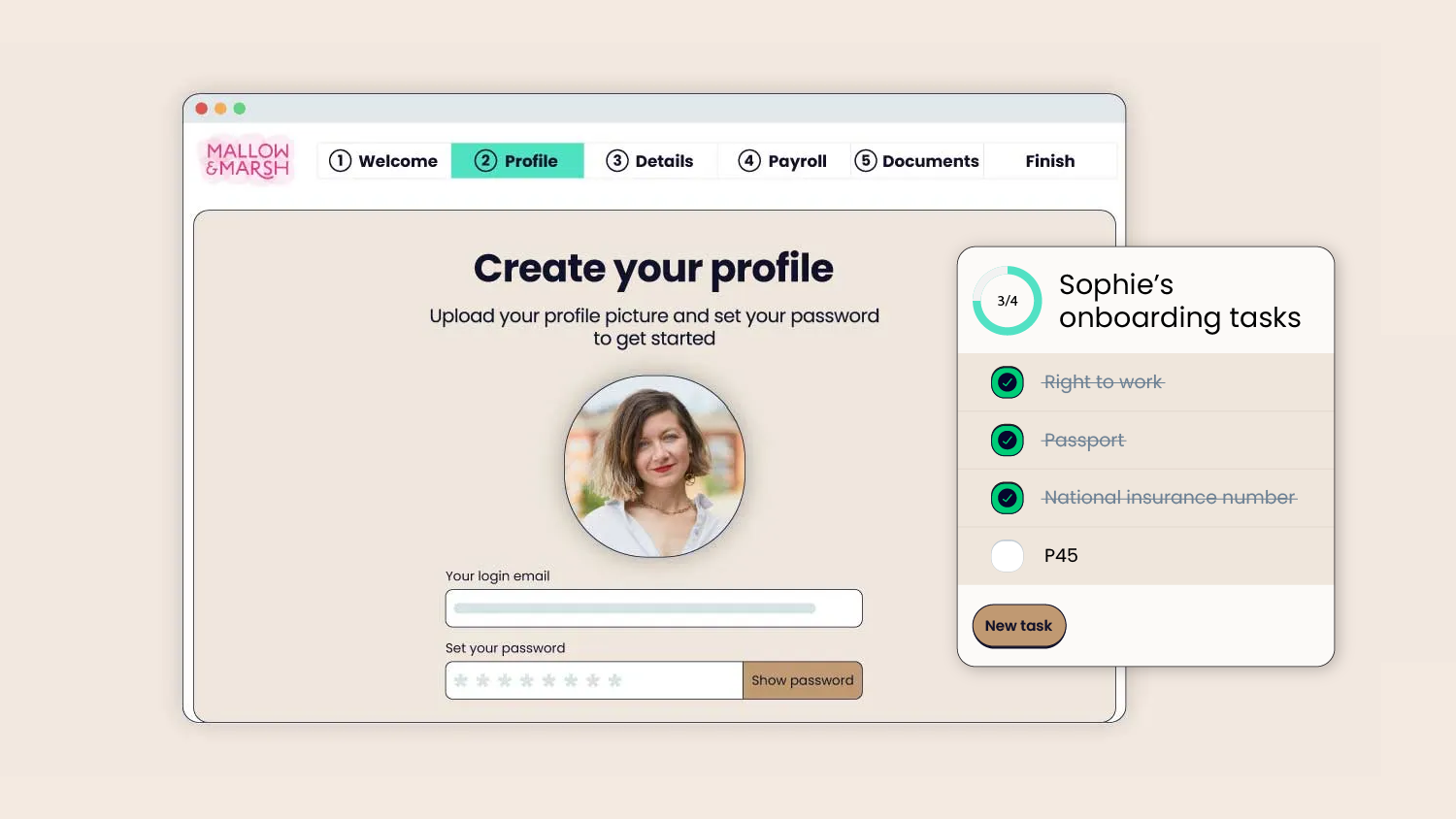
Drawing from real employee onboarding best practices is one of the best ways to improve your own process. Here are five onboarding experiences from small businesses that stood out to us, not because they’re flashy, but because they’re practical and worth borrowing from.
eduMe invites new joiners to company events before their start date – monthly all-hands, quarterly socials, even an offsite in Tuscany. As Marnie Richards, Head of People at eduMe, puts it: “We even invited four new joiners to Tuscany last year!”
Most companies treat the gap between offer acceptance and start date as dead time. eduMe turns it into a relationship-building window, so new hires arrive already feeling like part of the team rather than strangers walking in.
Every Friday of their first month, new joiners at Ourspace present to the whole team on a different theme:
This flips the usual dynamic of onboarding. Instead of information being delivered to the new hire, the new hire is given a platform from day one. It also builds feedback collection into the ritual, rather than treating it as an afterthought.
At Progression, onboarding is still handled by the two co-founders personally. New hires also get access to the company’s progression framework before they even apply, so they know exactly what’s expected and what the career path looks like.
It’s a reminder that small-business onboarding doesn’t have to copy enterprise playbooks to be good. The co-founder involvement creates a closeness and transparency that’s hard to replicate at scale – and giving candidates visibility of the framework before they join is a smart move most companies wouldn’t think to do.
At CharlieHR, our day three involves the new hire completing a “Manual of Me” – a document explaining how they work best, so colleagues can adjust to their working style rather than the other way round. Probation reviews are conducted against a formal progression framework rather than a subjective manager call, to keep the process fair.
The Manual of Me flips the usual assimilation dynamic – it says “we want to learn how you work”, not just “here’s how we work”. And assessing probation against a framework rather than manager gut-feel is unusually rigorous for a company of this size.
In small teams, it can feel lonely or unsettling knowing that you are responsible for a new hire’s experience in your company – especially when you don’t have the HR experience or resources yourself. But taking inspiration from other companies with a similar set-up shows you that it’s more than possible to build the best employee onboarding experiences in your company.
The 5 C’s of onboarding are a framework some companies use to structure their onboarding process: compliance, clarification, culture, connection and confidence (sometimes called check-ins). It’s a useful framework for thinking about best onboarding practices.
Technology today enables small businesses to automate tasks that used to be carried out manually – and onboarding is one of them. This technology usually enables teams to automate checklists to prepare for the new hire’s first day and assign to-do lists to other people in the team, enabling new hires to complete their own admin. Automating this side of onboarding leaves more room for the human part of onboarding, which is making sure new hires feel welcome and well equipped. If you want to learn more about it, I'd recommend reading our guides on automation vs onboarding software: Trello vs onboarding software and Notion vs onboarding software.
The best onboarding practices tend to share a few things: they start before day one with a welcome email and pre-boarding tasks, they assign clear ownership so nothing falls through the gaps, they make day one feel like a genuine welcome rather than pure form-filling and they build in regular check-ins that don’t trail off. They also take compliance seriously. Above all, they leave a good impression on the new hire.
The 30-60-90 onboarding process is a structured way of checking in with a new hire at 30, 60 and 90 days. At 30 days, you’re finding out how they’re settling in, whether they have any blockers and if they feel part of the team. At 60 days, you’re going deeper on role clarity, team integration and anything that’s come up since. At 90 days, you’re doing a formal probation review – setting objectives, agreeing on a development plan and confirming they’ve passed.
Most effective onboarding processes break down into five stages: pre-boarding (everything before day one – contracts, equipment, welcome communication), day one (introductions, IT setup, compliance briefings, making the new hire feel expected), week one (role clarity, daily check-ins, early goals, training), 30/60/90-day reviews (settling in, feedback, probation) and continuous onboarding (ongoing 1:1s, regular feedback loops and development beyond probation).
A new hire’s first onboarding start before day one. A warm, informative welcome email sent one to two weeks out sets the tone and gives them a genuine sense of who they’re joining. Regular communication and check-ins ensure they feel part of the team. The goal isn’t a polished experience – it’s to feel organised, welcoming and part of something great, so your new hire walks away from week one thinking they made the right move to join you.